Sharp-shinned Hawk

Sharp-shinned Hawk
Sharp-shinned Hawk, by Steve Thornhill

Tuesday, April 26, 2011

Prothonotary Warblers at Northwest River


Guest Blogger Shirley Devan back with an update on the nest boxes at Northwest River Park in Chesapeake. April 25 Brian Taber [President of CVWO and boat driver in above photo], Jan Lockwood [Williamsburg Bird Club member wearing the WBC hat], and I checked 58 nest boxes by motorized canoe – 39 boxes that have been in place for three years and 19 new boxes installed in mid-March.


Carolina Chickadees are early breeders and we found 9 CACH nests, most with eggs and two boxes with nestlings. April 25 was the birthday for one clutch of 5 and the other box had 4 nestlings 4 days old.


Twenty-four of the older boxes showed evidence of Prothonotary Warbler nest building – everything from 1” of moss to a complete nest with three eggs! Another nest had one egg. The eggs are creamy white with dark brown speckles. The nests are a combination of moss and cypress twigs, usually 2-3 inches of each with the cypress twigs on the top layer. We observed one PROW female approach a box with nesting material and another flew out of a box as we approached. Incidentally we observed a good size watersnake curled up on a limb nearby!


New boxes installed in mid-March are not seeing much activity – except from wasps. We did hear PROW singing near these boxes, but not in the quantity we observed in the area of the established boxes where we heard or saw a PROW near almost every box. We’ll see what happens to these new boxes as the nesting season progresses.

Saturday, April 16, 2011

Prothonotary Warbler box update at Northwest River Pk


Guest blogger: Shirley Devan, reporting from the Prothonotary Warbler nest box trail at Northwest River Park in Chesapeake, VA.

The Prothonotary Warbler boxes at Northwest River Park in Chesapeake are open and ready for birds to move in. And a few have taken us up on the offer.

April 13 and 14, Steve Living and I along with three volunteers, Les Lawrence, Janet Lockwood, and Geoff Giles, checked over 80 boxes by motorized canoe and discovered 9 Carolina Chickadee nests (no nestlings yet), one Prothonotary Warbler nest, and quite a few wasp nests. Male Prothonotary Warblers are definitely back in Virginia – seen and heard everywhere along the box trail.

This citizen science project is supervised by Dr. Bob Reilly, Master Bander and VP of CVWO and Professor in the Center for Environmental Studies at VCU, with assistance from Steve Living, Wildlife Biologist with VA DGIF and Shirley Devan, Williamsburg Bird Club and Historic Rivers Chapter, VA Master Naturalist.

Above is a photo of the Prothonotary Warbler nest found April 14, constructed with cypress twigs. Also, a photo of Steve Living driving the boat and "happy" Les Lawrence installing “false fronts” on the boxes to help us capture male Prothonotary Warblers later in the season as they feed the nestlings.

Sunday, April 3, 2011

Big Day at College Creek Hawkwatch


Today, Fred Blystone, Bill Williams, Shirley Devan and I were on hand for the 3rd best day in the 15 years of the hawkwatch. We saw 146 birds of 10 species and set a new daily high for Northern Harriers at 10. The photo is one of today's closer birds, an immature Bald Eagle. We also saw 2 Purple Martins, a few Barn Swallows, 2 Dunlin, 6 Lesser Yellowlegs and 2 very high Common Loons. The wind was light west and southwest...strong sun and temperatures 50-60 F. Tomorrow is expected to be an unseasonably warm 80+ degrees with strong winds and severe storms at the end of the day. Despite very poor migration conditions during the last 10 days in March...cold temperatures, strong north winds, rain and snow flurries...we are far ahead of the average season pace.


Totals


Black Vulture 20


Turkey Vulture 71


Osprey 35


Bald Eagle 2


Northern Harrier 10 (new daily high)


Sharp-shinned Hawk 3


Red-shouldered Hawk 1


Red-tailed Hawk 1


American Kestrel 2


Merlin 1


Brian Taber

Sunday, March 20, 2011

1,000th Bird at College Creek


Today we reached the 1,000th bird of the season and it's the earliest date, by 10 days, than for any of our 14 previous seasons. The event usually occurs in early to mid-April. The bird was, not surprisingly for the early season, a Turkey Vulture. The past 4 day totals of 63, 120, 108 and 51 are very impressive for the site.

Brian Taber

Saturday, March 12, 2011

Prothonotary Boxes at Northwest River


Thanks to Shirley Devan (her photos), of the Williamsburg Bird Club and the Historic Rivers Chapter of VA Master Naturalist and Stephen Living and Erik Brittle of the VA Department of Game and Inland Fisheries and CVWO Vice-president and Master Bander Bob Reilly, 60 more Prothonotary Warbler nest boxes were installed at Northwest River Park in Chesapeake on March 11th. There are now 100 boxes there and the site is part of the important and growing network of Prothonotary researchers, studying this species of special concern.
Brian Taber

Monday, February 28, 2011

Glaucous Gull at College Creek Hawkwatch


This imm. Glaucous Gull, a new species for the hawkwatch, flew past this morning.

Brian Taber

College Creek Hawkwatch Feb Summary


Due to some unusually good weather for February and excellent coverage, we were able to shatter the previous high total for February, which was 204 in 1998. This February, with 19 days coverage, we recorded 344. As usual, Turkey Vultures made up the bulk of the early season flight, but our 8 species included 16 Black Vultures, 5 Ospreys, 12 Bald Eagles, 3 Northern Harriers, 1 Sharp-shinned Hawk, 1 Cooper's Hawk and 13 Red-tailed Hawks. A Peregrine, quite rare at this site, seen on February 24th, was headed south across the river and so not counted. Also on that day we saw 135 Tundra Swans. We have seen 2 Lesser Black-backed Gulls, the Glaucous Gull noted above, a few Tree Swallows and dozens of crows crossing the river, most of which did not vocalize.

The dark domes are the Surry Nuclear Power Plant, 2 miles across the James River to the south, the map shows the point of land at Hog Island Wildlife Management Area which the birds follow and the sign provides a bit of history.

Brian Taber


Thursday, February 10, 2011

College Creek Hawkwatch Begins


We got off to a chilly (28F) start for the 15th consecutive late winter/spring hawkwatch at College Creek on Feb 9th, but Tom Armour, Fred Blystone and I were rewarded with 11 Turkey Vultures crossing the river on a southeast wind. We started a day earlier than scheduled due to predicted snow on Feb 10th. The hawkwatch is located on the James River, 3 miles southeast of Williamsburg, on the Colonial Parkway and operates daily through May, weather permitting, from mid-morning to early afternoon, when birds use the warming air to make the water-crossing. We often see a wide variety of other migrants, including shorebirds, waterfowl and swallows. Data is posted on Hawkcount.org site and regular updates are made to the VA List Serve and this blog. Visitors are always welcome, feel free to e-mail me directly for more information.

Brian Taber


Thursday, January 27, 2011

Snow Buntings


These are part of a flock of 31 at Craney Island, Portsmouth today.

Brian Taber

Sunday, January 16, 2011

Winter Boat Adventure


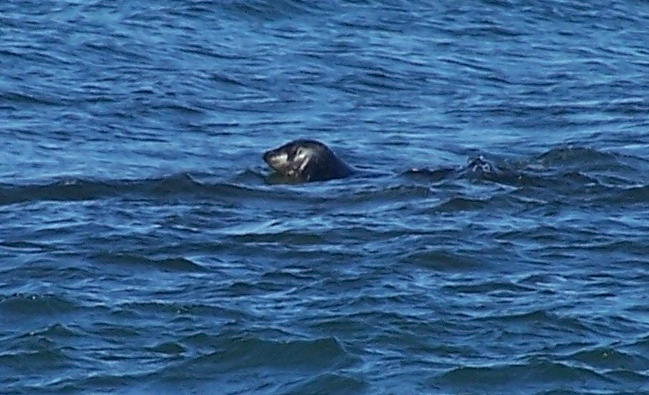
I was asked to lead a birding boat trip out of Lynnhaven, Virginia Beach, yesterday, organized by the Williamsburg Bird Club, aboard the "Bay Princess." Our captain said the very cold 37 degree water at the mouth of Chesapeake Bay had forced many fish and birds at least 50 miles south...we didn't see a single Northern Gannet which are usually plentiful. The air temperature was also in the 30s as we cruised along the Chesapeake Bay Bridge-tunnel, almost to the Eastern Shore. We were treated to a spectacular assemblage of at least 15 seals...photo by Seig Kopinitz...of a varierty of colors...usually we only see Harbor Seals....the single swimming seal picture appears to be a Gray Seal by the head profile, which would be quite rare this far south...another seal in the middle of the photo and the one to the far right appear to have much smaller, different-shaped heads. Comments are welcome. Thanks to some chumming of cut menhaden by the first mate, we had a following of hundreds of gulls.

Birds seen were:
Common Loon 3
Brown Pelican 2
Great Cormorant 12
Double-crested Cormorant 1,250
Brant 6
Lesser Scaup 440
Greater Scaup 10+
Long-tailed Duck 9
Black Scoter 13
Surf Scoter 625
White-winged Scoter 1
Bufflehead 800
Red-breasted Merganser 25
Osprey 1
Peregrine 1
Ruddy Turnstone 5
Sanderling 20
Purple Sandpiper 12
Bonaparte's Gull 16
Ring-billed Gull 135
Herring Gull 550
Lesser Black-backed Gull 2
Great Black-backed Gull 35
Brian Taber

Wednesday, December 1, 2010

Fall Raptorthon


On November 30th, the Observatory participated again in the "Raptorthon" for the Hawk Migration Association of North America (HMANA) as we did last spring at College Creek Hawkwatch... an event to help raise awareness and funds for hawk conservation. We report our data to the HMANA website at Hawkcount.org and their Raptor Population Index project uses such data for their excellent reports, such as "The State of North America's Birds of Prey," in 2008. HMANA coordinates the largest network of raptor migration monitoring sites in the world. To learn more, visit the HMANA.org website. Tax-deductible donations may be made directly to them or through CVWO for your support of the Raptorthon.

That's Kiptopeke Hawkwatcher Zak Poulton in the Raptorthon shirt...in 70 degree temperatures and strong south winds, we found 11 birds in 8 hours (2 Northern Harriers, 5 Sharp-shinned Hawks, 2 Cooper's Hawks and 2 Red-tailed Hawks) to end our season.

Brian Taber

Sunday, November 21, 2010

750,000th Bird Update

Well..this milestone will just have to happen next September..it's clear that with migration winding down, the 750,000th bird at Kiptopeke Hawkwatch will not come by this month...we'll post more information about it starting August 2011...thanks to all those who sent in predictions for the contest!
Brian Taber

Tuesday, November 16, 2010

Merlin Meal


Fantastic photo by Steve Thornhill, taken recently at the Kiptopeke Hawkwatch, of a Merlin enjoying a favorite meal...dragonfly!

Brian Taber

Friday, November 12, 2010

Black-chinned Hummingbird


The purple gorget is evident in this adult male Black-chinned Hummingbird, found and photographed by Mark Mullins in Pulaski County, Virginia, where it stayed Nov 8-11. The species typically occurs west of the Great Plains.

Brian Taber

Saturday, November 6, 2010

750,000th Bird Update

The Kiptopeke Hawkwatch has seen a recent slowdown, even though Northern Goshawks and Golden Eagles have appeared.....and the total as of Nov 3rd is 21,837....to get to 750,000 we have to reach 26,833....it should be close, so send in your predictions (see related piece just below)!
Brian Taber

Friday, November 5, 2010

The Feeders at Kiptopeke


With the recent cooler weather, the bird feeders at the Kiptopeke Hawkwatch have suddenly become very busy, with many American Goldfinches, Purple Finches, Red-breasted Nuthatches and Pine Siskins (above) joining the more usual species.

Brian Taber

Tuesday, November 2, 2010

Selasphorus Hummingbird


This hummer, rare in the east and identifiable only to the genus Selasphorus, was at the Kiptopeke Hawkwatch platform feeder on Oct 26th...photo by Zak Poulton.

Brian Taber

Monday, November 1, 2010

Northern Goshawk at Kiptopeke!


Terrific photo by Steve Thornhill, of the immature Northern Goshawk that flew right over the Kiptopeke Hawkwatch on Oct 30th.
Brian Taber

Friday, October 22, 2010

750,000 Birds!


The Kiptopeke Hawkwatch is closing in on a remarkable milestone...750,000 birds! See the button on the left side of our Home Page to enter our contest!

Regular updates to our season totals will be posted here. The total as of Oct 20 is 20,037 and we need to get to 26,833!

Brian Taber

Tuesday, October 12, 2010

More Bird Habitat at Kiptopeke


On October 8th, a ribbon-cutting ceremony was held to officially open the newly-acquired "Taylor Pond" area at Kiptopeke State Park. It was made possible through the efforts of those pictured and also singer/songwriter/environmentalist James Taylor, who donated proceeds of a concert held in Virginia Beach. Pictured, from the left are: Fred Hazelwood, District 1 State Parks Manager; Sam Sweeney, Kiptopeke Park Manager; Steve Parker, The Nature Conservancy; Willie Randall, Northampton County Board of Supervisors; Jack Humphries, Eastern Shore Master Gardeners; Laura McKay, VA Department of Environmental Quality, Coastal Zone Management; David Johnson, Director, VA Department of Conservation and Recreation and Daniel Jordan, Assistant Park Manager at Kiptopeke. Trees and other native plants were installed in recent weeks, which, in addition to the freshwater pond, will provide crucial stopover resources for migrant birds at this globally important natural area.
Brian Taber

Monday, October 4, 2010

Northern Wheatear


Paul Nasca digiscoped this very rare Northern Wheatear at the Chincoteague causeway...he and the Fredericksburg VA Birding Club found it Oct 2nd.

Brian Taber

Tuesday, September 28, 2010

Monarch Migration on the Eastern Shore


These are some of the estimated 10,000+ Monarchs at a rare roost site at the tip of Virginia's Eastern Shore on Sept 20th. They were found and photographed by CVWO Monarch Researcher Kaitlyn Parkins.

Brian Taber

Sunday, September 19, 2010

Late Day Merlins


At the Kiptopeke Hawkwatch, in September, flights usually last all day, with Merlins typically the only hawks flying late in the day...these were there yesterday, still moving at sunset.

Brian Taber

Thursday, September 16, 2010

Coyote!


After living in Virginia for 40 years, this is the first coyote I've seen here...today at Craney Island, Portsmouth....yet another threat to the colonial nesting birds there.

Brian Taber

Wednesday, September 15, 2010

White-cheeked Pintail


Distant picture, but still showing the famous cheeks...and even a bit of the red bill base...of the White-cheeked Pintail, found at Chincoteague right after Hurricane Earl blustered up the east coast, Sept 2nd. Could it have been storm-blown?

Brian Taber

Monday, August 23, 2010

Buff-breasted Sandpiper and Caspian Terns at Hog Island


Today, the juvenile Buff-breasted Sandpiper that Adam D'Onofrio found yesterday was still at Hog Island Wildlife Management Area in Surry County, along with a staggering assemblage of 811 Caspian Terns, an apparent State high count.


Brian Taber

Wednesday, August 4, 2010

Piping Plover


This Piping Plover was on the Chesapeake Bay shoreline at Grandview Beach, Hampton today.....with Semi-palmated Plover in 2nd image.

Brian Taber

Sunday, August 1, 2010

Fall Programs

The Observatory's late summer and fall migration programs will be up and running soon at Kiptopeke State Park on the the Eastern Shore. Calvin Brennan, our hawkwatcher last year, is returning as head songbird bander and Zak Poulton, who manned the Seaside Hawkwatch last year will be our Kiptopeke Hawkwatcher. Bob Chapman is also returning to band hawks. The songbird station is scheduled to begin by August 18th and the hawk programs begin Sept 1st.

Katlyn Parkins is our Monarch butterfly migration person, who will begin tagging and counting Sept 15th.

These programs operate daily, weather permitting and you can follow the Kiptopeke Blog for regular updates about the migration.

Brian Taber

Monday, July 19, 2010

Annoyed


This displeased Barred Owl was being harassed by American Crows the other day, in my yard here in Williamsburg.

Brian Taber

Friday, July 2, 2010

Scotland


I know this is a Virginia blog...but I wanted to share a few images of my June Scotland trip...and the Northern Fulmar and Common Eider are familiar to Virginia birders....Lapwing is recorded on the east coast....the Whinchat is a Turdidae "cousin" of wheatears...and the Red Kite...here in heavy molt...is making a comeback thanks to conservationist's efforts...and a Loch Ness image...is that something in the water?

Brian Taber

Saturday, June 12, 2010

College Creek Hawkwatch Season Ends

The 14th consecutive late winter/spring hawkwatch at College Creek ended on May 30th. It began on February 12th and coverage was 68 days (6th highest) and 130.75 hours (4th highest). The total was 1550, the 3rd highest.

Bald Eagles set a new season record of 150, thanks to 2 remarkable days in May (see Blog posts below) and the Osprey total of 266 was also a new season record.

Turkey Vultures at 917 were the 4th best, Black Vultures at 41 were only 8th best as were Northern Harriers, at 30. A rather low Sharp-shinned Hawk total of 45, combined with a high Cooper's Hawk total of 22, to make the ratio of Cooper's to Sharp-shinneds a startling 48%....that compares to 12% and 20% for 2009 and 2008 respectively.

There were 2 Mississippi Kites on May 16th, a species that was widely reported in Virginia this spring. Only 2 years have seen fewer than our 3 Broad-winged Hawks, though they are rare at this water-crossing site and are never seen in flocks here. Red-shouldered Hawks are sporadic and were about average at 5, Red-tailed Hawks at 45 were the 4th best, though far below the record 68.

American Kestrels at 20 were fewer than last year's 33, though better than the previous 4 years. There were 2 Merlins, always rare at the site and no Peregrines, though a Peregrine seen at Hog Island on May 2nd likely flew across the river and past College Creek.

The 1,000th bird of the season was recorded on April 5th, the 2nd earliest date for that event, however, the second half of the season slowed considerably with only 522 birds or 37% of the season total seen after the midpoint, April 7th.

Six American White Pelicans were seen on 2 April dates for a great non-raptor highlight and there were many excellent swallow flights and even some good flights of butterflies crossing the river when winds were strong from the southwest.

The complete data is on the Hawkcount.org website. For more details about the hawkwatch, please contact me directly. Thanks again to the other regular volunteers Tom Armour, Bill Williams and Fred Blystone.

Brian Taber

Sunday, June 6, 2010

Nighthawk Nest


This female Common Nighthawk was on a nest at Craney Island, Portsmouth, last month.
Brian Taber